Microsoft certification exam question types, with examples
Microsoft exams mix several question formats, and the unfamiliar ones cost time on exam day. Here is each format with a worked example and a tip. Microsoft's own exam sandbox shows the exam screens themselves.
Single answer
One correct option out of several.
Example · AZ-900 · Azure architecture
What is the main purpose of an Azure resource group?
A logical container for resources that share a lifecycle, so you can deploy, manage and delete them together
A physical datacenter in an Azure region
A billing account that receives the invoice
A network that connects virtual machines
Show answer
Answer: A (A logical container for resources that share a lifecycle, so you can deploy, manage and delete them together)
Resource groups organize related resources, such as the web app, database and storage for one solution, so you can manage access, costs and deletion as a unit.
Tip: Read every option before you answer. Wrong options are often true statements that don't answer the question asked.
Multiple answers
The question tells you how many options to choose, such as "Choose 2".
Example · PL-300 · Prepare the data
Which two Power Query transformations help clean inconsistent data before it reaches your report? (Choose 2)
Replace values
Bookmarks
Remove duplicates
Sync slicers
Show answer
Answer: A, C (Replace values; Remove duplicates)
Replace values and Remove duplicates are Power Query transformations. Bookmarks and sync slicers are report features and don't change the data.
Tip: Choose exactly the number asked, and judge each option on its own.
Yes/No statements
Several statements about one topic. You mark each one Yes or No.
Example · AZ-900 · Management and governance
For each statement, select Yes if the statement is true. Otherwise, select No.
Azure Policy can block resources from being created outside approved regions. (Yes / No)
A resource lock prevents users from viewing a resource. (Yes / No)
Tags on a resource group are automatically copied to every resource in it. (Yes / No)
Show answer
Yes
No
No
Azure Policy can deny non-compliant deployments. Locks stop deletion or changes, not reading. Tags aren't inherited by default; Azure Policy can add them.
Tip: The statements are independent: one being true says nothing about the others.
Hotspot with drop-downs
Each row or gap has its own drop-down list, often inside a sentence, a command or a diagram.
Example · PL-300 · Visualize and analyze the data
Select the most appropriate Power BI visual for each requirement.
Show how monthly revenue changed over the last year. (Line chart / Card / Pie chart)
Show a single headline number: total revenue this year. (Line chart / Card / Pie chart)
Show answer
Line chart
Card
Line charts show trends over time; cards show one value. Pie charts show how parts make up a whole.
Tip: Treat each drop-down as a separate question. The same option can be right in more than one row.
Drag and drop: matching
You drag items into the targets they belong to.
Example · DP-900 · Core data concepts
Drag each task to the type of workload it belongs to.
Targets: Transactional (OLTP) · Analytical
Recording a card payment at checkout
A five-year sales trend report
Updating a customer's shipping address
A dashboard of average delivery time by region
Show answer
Recording a card payment at checkout → Transactional (OLTP)
A five-year sales trend report → Analytical
Updating a customer's shipping address → Transactional (OLTP)
A dashboard of average delivery time by region → Analytical
Transactional workloads record individual business events quickly and reliably. Analytical workloads summarize lots of historical data for reporting.
Tip: A target can take more than one item, so don't spread items out just to fill every target.
Drag and drop: complete the code
You drag keywords or values into gaps in code or a sentence. Some choices are not used.
Example · DP-600 · Query and analyze data
Complete the query so that it returns total sales for each region. Not every keyword is used.
Choices: SUM · GROUP BY · COUNT · ORDER BY
SELECT Region, ___(Amount) AS TotalSales FROM Sales
___ Region;
Show answer
SELECT Region, SUM(Amount) AS TotalSales FROM Sales
GROUP BY Region;
SUM adds up the amounts, and GROUP BY returns one row per region. COUNT would count rows instead of adding amounts.
Tip: Read the code around each gap first; it usually rules out most choices.
Exhibits
A screenshot, diagram, table or code sample that the question refers to.
Example · DP-900 · Core data concepts
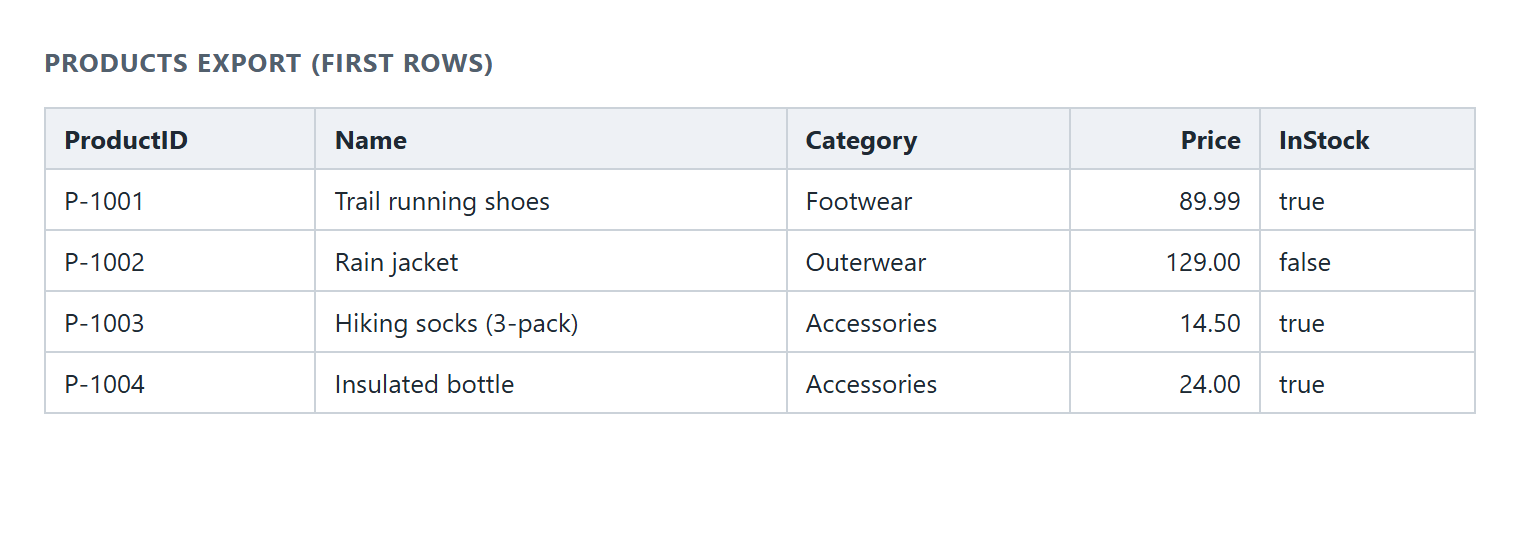
The exhibit shows data exported from an online shop. How is this data best described?
Unstructured data
Structured data in a fixed schema of rows and columns
Semi-structured data with a different shape for every record
Streaming data
Show answer
Answer: B (Structured data in a fixed schema of rows and columns)
Every row has the same columns with consistent data types, which is the definition of structured, relational data.
Tip: Open the exhibit before reading the options. The answer usually depends on one detail in it.
Case studies
A case study describes one company across tabs such as Overview, Existing environment and Requirements, followed by several questions about that scenario. Each case study is a section of its own: once you submit it, you can't go back to it.
Tip: Read the requirements first, then go back to the other tabs for the details each question needs. Review any questions you marked before you submit the section.
Databricks and Snowflake exams
Databricks exams are multiple choice, often with code and exhibits. Snowflake exams also have multiple-select questions.
Practice every format
ExamKite's Microsoft practice tests use all of these formats, including case studies in the same layout. Pick your exam: